ALIEN POETRY – ADDITIONAL INFORMATION
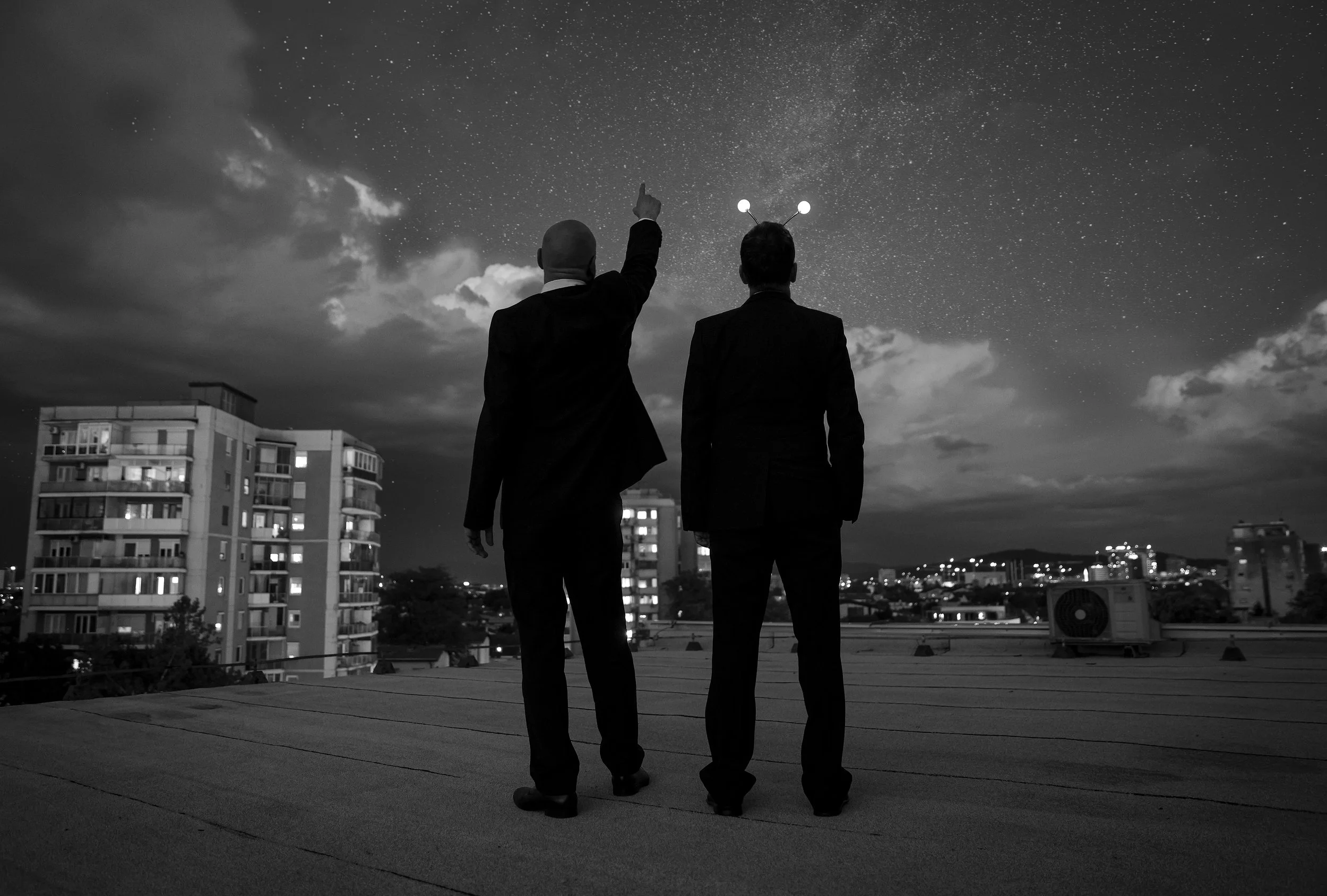
Photo: Jože Suhadolnik
ABOUT OUR NEW LAST ALBUM
Whenever you release a new record, it is your last one. Not just the last in line: there is also an ever increasing possibility that it is truly the last, the final one. After all, you never know what will happen tomorrow. If you kick the bucket (unfortunately, it is an unavoidable inconvenience), the album will become your closing statement.
This is, admittedly, a rather morbid realisation. However, it provides valuable motivation. It sharpens your thoughts and yields richer, more flavoursome results.
If you do a respectable job, you give yourself permission to die serenely, without regrets. You won't have to return as a singing or piano-playing ghost... and terrify the living.
Given that you're reading this, you're probably interested in our work. Here's the uplifting part — for both you and us. If it turns out that Alien Poetry is not just temporarily our last album, we will not be coming back to haunt you.
We're pretty happy with our new last words. We hope you enjoy them.
Silence, 2026
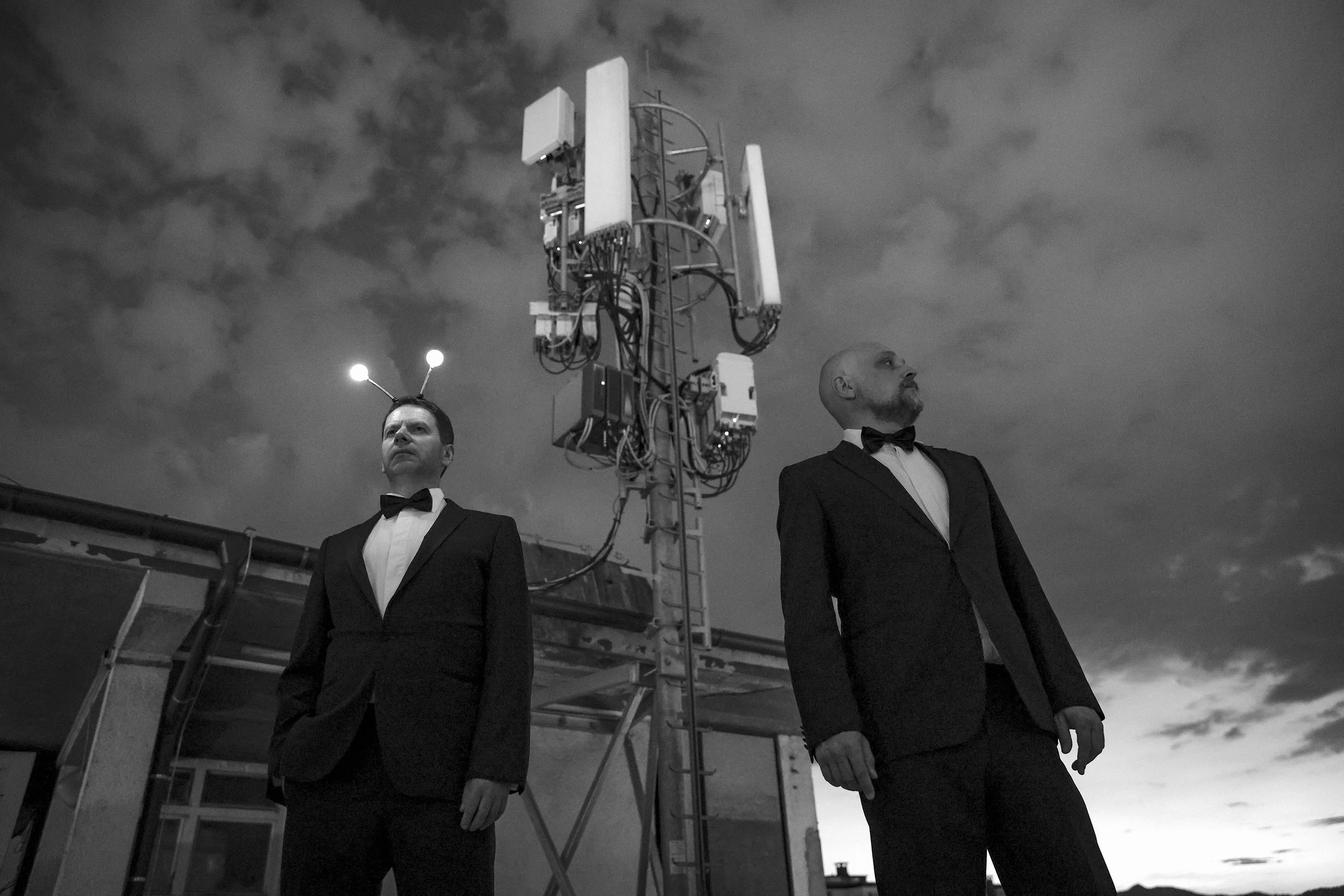
Photo: Jože Suhadolnik
BENKO’S SONG-BY-SONG COMMENTARY
Tonight, We Are All Your Children
The first song on the album was actually the last one written. The song was a reaction to the genocide in Gaza, a child of frustration.
One of the most chilling aspects of the bloodshed was the world's silence. Nonchalance became international policy, protocol. Suddenly, everything was acceptable: the systematic levelling of a city, the killing of journalists, starvation campaigns, bombed hospitals, more than 20,000 dead children... The grim lesson of Gaza is that that no horror is too great to ignore.
Unfortunately, Gaza is not the only example of this head-in-the-sand approach, just the most blatant. Many emergencies — climate change inadvertently springs to mind — are unaddressed with similar thoroughness.
It sounds paradoxical, but nothing changes the world quite as drastically and irrevocably as doing nothing. Indifference is a brutal, devastating force, one that is remarkably hard to counter.
Light (A Kind of Braille)
When things grow dark, Hladnik and I can always rely on a small, friendly light to illuminate our way. I am, of course, talking about music.
To quote Kurt Vonnegut:
If I should ever die, God forbid, let this be my epitaph:
‘The only proof he needed for the existence of God was music.’
Two Fools
The end of the world comes in many forms. It can be a collective experience, like climate breakdown, or a very personal one, like developing a serious illness or growing old. When confronted with an evaporating future, it takes a special kind of madness to avoid succumbing to depression and apathy. The trick is not to die ahead of time, to continue living — with undiminished passion — to the very end.
A passage from Arthur Miller’s Salesman in Beijing comes to mind: On the day the world is blown up, the playwright whose show opened the night before will be leafing past the news section of the Times to find his review -- as he ascends through the stratosphere, oblivious.
It is an impressive trick, ignoring the end of the world. I'm hoping Hladnik and I will be like Miller's playwright, too busy to notice.
Two Fools is also about companionship, the importance of finding like-minded fools. Unlike regular fools, like-minded fools are incredibly rare. In this regard, I have been immensely lucky.
I will stop now, before I start sounding like a sentimental old goat.
Slave to the Algorithm
We enjoyed working on the new songs, especially the recording sessions with the RTV Slovenia Symphony Orchestra. We were happy with the results. Which is why, for some strange reason, the idea of releasing the album felt like a mistake.
For a while, we considered not releasing the songs. We were unable to escape the impression that releasing them might not be in their best interest.
Like many musicians, we have a highly idealised view of music. To us, it is fascinating and precious. The world, on the other hand, keeps convincing us that this is not the case.
As you know, songs are now made by artificial general intelligence. They're churned out like cappuccinos from a coffee machine. Every single day, circa 75,000 AI-generated songs are uploaded to digital platforms.
As a result, releasing music has become an effective way of hiding it. You feel as though you are dropping your work into a bottomless pit. It falls for the longest time, like Wile E. Coyote falling from a cliff, and barely makes a sound when it lands.
These days, it is hard to be enthusiastic about releasing music. It is hard not to see it as an exercise in futility. What should be a celebration feels more and more like a burial.
Eventually, we released the album. Not doing so would be foolish — after all, we earn our living through music. However, we don't regret the time it took to decide whether to release the album or keep it to ourselves. The delay felt oddly right; it was time well spent.
At least for a while, the music felt special, as it should.
Lullaby
On September 2nd 2015, Alan Kurdi, a two-year-old Syrian boy, drowned in the Mediterranean Sea along with his mother and brother. Alan's father experienced an even crueller fate: he survived.
Lullaby was inspired by their story.
When Alan died, I honestly believed the world would finally react, do its best to prevent the needless deaths of refugees. I was fascinatingly naive. In reality, governments did the exact opposite: they implemented policies that resulted in even more suffering and death. The Mediterranean Sea turned into a graveyard.
For a long time, I saw Alan's death as a turning point, the onset of a new era. I thought the old world, with its humanist values and unalienable rights, was crumbling, giving way to a new, dystopian reality, in which even the suffering and deaths of children were acceptable and commonplace.
It took me a very long time, I'm ashamed to admit, to realise that the old world never really existed.
Artistic Swimming for Boiling Frogs
This one is fully autobiographical.
A Little Something Besides Everything
A Little Something Besides Everything was inspired by three lines from two poems.
The first line is from Anaïs Nin's prose poem House of Incest:
I walk ahead of myself in perpetual expectancy of miracles.
The second and third are from Louise Glück's poem Nostos:
We look at the world once, in childhood.
The rest is memory.
The Coldest Fire
If there is a recurring theme in popular music, it is the power of love. In countless songs, love is depicted as a mighty, all but unstoppable force.
In reality, love is a permanent underachiever. Despite its enormous potential, it has never evolved into something widespread, dominant. It has never conquered the world. It has never gone viral.
To most people, an epidemic of love — a world love, if you will — is a foolish notion. It is ridiculous, inconceivable. However, an epidemic of hate — a world war, if you will — is perfectly imaginable. It doesn't take much effort for us to envision a global war, a nuclear holocaust, a self-inflicted end of the world.
Animosity is, as it seems, more in tune with us. It resonates better with our true nature. As Stephen King once wrote: Some werewolves are hairy on the inside.
The Night Watch
The Night Watch was originally written for Tomaž Pandur's 2011 play War and Peace. The title was Tomaž's idea: he said the theme reminded him of Rembrandt's famous painting.
Over the years, we recorded several versions of the piece. However, we were always slightly dissatisfied with the results.
During the making of the album, we decided to give The Night Watch another go. The new arrangement was shaped by a chance rewatch of Sergio Leone's 1968 masterpiece Once Upon a Time in the West. Hladnik wrote the orchestral arrangement under the influence of the late maestro’s legendary score.
In the film's main theme, Morricone used the harpsichord. We opted for a similarly sounding instrument, the zither. It is a traditional instrument in our homeland. We worked with an outstanding zitherist, Irena Anžič, with whom we often collaborate.
A mere fourteen years after its creation, we are finally happy with the piece. All it took was a fistful of Morricone.
I Am Written
I thought it would be interesting to write a few words about the process of writing words. As a lyricist, I have an intense, highly ambivalent relationship with words. I love them, even though they regularly drive me crazy.
I Am Written is a small manifesto, a tribute to the transformative potential of words. I believe the easiest way to change is through one's choice of words. Words are, in a way, a self-fulfilling prophecy: by paying attention to the words we use, we reformulate, rewrite ourselves. I like to regard them as an excavation process; a tool for unearthing a slightly better — or at least more interesting — version of yourself.
Alien Poetry
It’s hard not to see the world as a big internment camp.
You're at the mercy of the camp administration. People are regularly exploited, quite a few are killed. Many are hungry. Work is mandatory — eight hours a day. The assignments are mostly soul-crushing and pointless. Last but not least, you cannot leave. Escape is impossible.
Those who roam the camp in search of better conditions are called “aliens”.
Why do the other internees call them “aliens”? Because of their outlandishness, of course. After all, these people are risking their lives to pursue a mirage. They dream of an alien world: a better, kinder place. They might as well be dreaming of life on a different planet.
To be honest, it's hard to decide who is more unreasonable: the foolish “aliens” who are trying to flee from the inescapable... or the internees who accept — and even aggressively protect — the internment camp they were born into.
It's a matter of perspective, really.
In my opinion, we should all apply for alien citizenship.